Showing posts with label Beech Mountain Beekeeping. Show all posts

Thursday, May 4, 2017

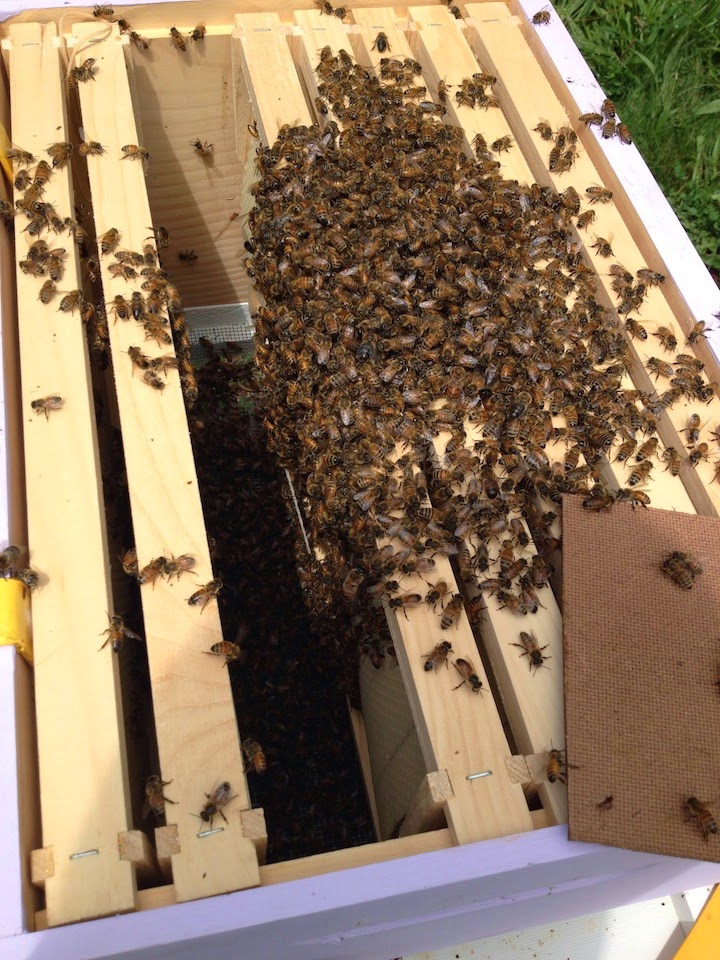
Installing my Nucleus Hive of Honeybees


  1. Collected my nucleus hive of bees from Beech Mountain Beekeeping. Secured in car to make sure no bees can escape during the journey to Banner Elk.
  2. Placed nuc hive in position near the hive stand.
  3. Placed new hive on the stand, with the entrance block in place to reduce the entrance.
  4. Sprayed three empty frames with sugar water.
  5. Opened nuc hive and gently smoked the bees.
  6. Lifted out first frame of bees and placed in hive.
  7. Continued to transfer remaining frames of bees.
  8. Added one frame of foundation at front and in-between each frame of bees.
  9. Shook any bees still in the nuc hive into the new hive.
  10. Fitted crown board and the hive roof.
  11. Gave the bees a feeder full of syrup. Will continue feeding until the bees have drawn out all the frames of foundation.

Sunday, August 10, 2014

Adventures in Beekeeping - Year Two


Picking up my bee package from Beech Mountain Beekeeping. 


Sunday, December 8, 2013

Getting Ready to Close for the Winter!


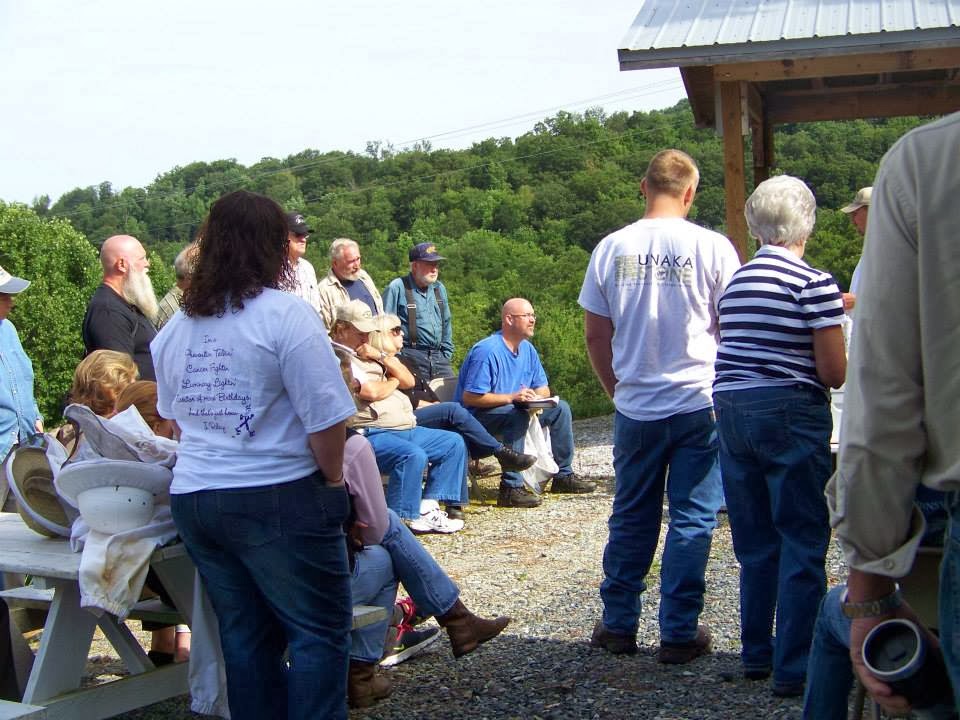
Participated in a hands on field day at Beech Mountain Beekeeping on Saturday, August 17. During the class participants learned how to apply pesticides for mites, treatments for nosema, feeding and food supplements for winterizing bees.  

Getting ready to apply Apiguard, a natural non-toxic treatment, used to control varroa mites in honeybee colonies. 

Installed a mouse guard to prevent mice from entering the hive. The girls are busy on this autumn day bring in pollen from the goldenrod.
Added a weatherproof hive wrap to help protect the bees from the fall and winter elements.


Thursday, September 26, 2013

Catching a Bee Swarm - Part 1

Swarming is an instinctive part of the annual life cycle of the honeybee. This swarm landed on a limb nearby our apple orchard. After they land, scout bees are sent out to find a permanent home. When they return, they will do a dance that indicates the direction of the new home so if you want free bees you need to catch them soon.


Catching a Bee Swarm - Part 2


Mark from Beech Mountain Beekeeping is using a bee brush to brush the bees on the frame. Then the frame is placed in the swarm box. Once bees start going into the box, the rest will follow like ants marching to the ant hill.


Catching a Bee Swarm - Part 3

Ready to capture the swarm, a cloth was laid out below the swarm in front of the swarm box. The majority of the bees have been shaken on to the cloth and have begun entering the hive.


Tuesday, August 20, 2013

Buckwheat for Bees

Being a new beekeeper and wanting to have plants for the bees to forage, buckwheat seems to be a good nectar source for honey beekeepers to provide for bees. I bought two packages of buckwheat seed as a lark
at Beech Mountain Beekeeping and sowed the seed randomly in the field near the beehive.  
Typically the seeds should germinate and emerge within three to four days. Plants grow rapidly, producing small heart-shaped leaves with slender, hollow stems. Surprisingly the flowers began to appear about three weeks after planting. 
Buckwheat (Fagopyrum esculentum) is a broadleaf plant native to northern Asia. The seeds are brown in color, roughly the size of a soybean, irregularly shaped, with four triangular surfaces. At the peak of flowering, the buckwheat plant has striking white petals. After a flower is pollinated, a full-sized seed will form within 10 days. Seeds appear and mature earlier on the lower stem, with seed development continuing up the stem as the plant matures.  The bees are very happy!

Thursday, June 6, 2013

Installing A New Bee Package

As a new beekeeper here are the steps that were taken to install a new bee package in a hive. Some of these pictures were taken at a session demonstrating how to install a bee package at Beech Mountain Beekeeping where I picked up my  bee package on Saturday May 18th and some photos were taken in my bee yard that same day:

1.  Spray a generous amount of sugar syrup on the bees.


2.  Remove three to four frames from the center of the hive.


3.  Pick up  the package and sharply knock it on the ground to remove the bees from the sides and top. 

4.  Using a hive tool, pry up and remove the can of sugar syrup from the package


5.  Turn the package over with the opening directly over the top of the hive and shake the bees out of the shipping package directly into the frames.  I didn't shake enough bees out of the cage but they eventually left the cage and went into the hive.


6.  Remove the cork from the candy end of the Queen Cage for workers to eat through the candy to release the Queen.


7.  Using two rubber bands securely attach the Queen Cage to the frame which was previously removed with the mesh screen facing outwards between frames.


8.  Replace the frames that were removed in Step 2 and replace inner and top covers.
9.  Pour any remaining contents of the syrup that shipped with the Bees into the feeder jar and top off with sugar syrup.
10. If any bees are still remaining in the cage package, place in front of the hive and they will join the other bees.